
Keep it Quiet
Precision Signal Conditioner.
Overview
Eurorack signals are loud. Audio and CV alike typically swing to ±5V, and dialling in subtle modulation means fighting parameters not designed for fine control. Keep it Quiet (KIQ) puts a dedicated, high-resolution level control on every signal before it goes anywhere.
At its core
Four identical channels, each combining full-travel log-taper attenuation with an instant polarity switch: no centre-detent compromise, no lost resolution. Left unpatched, the channels normalise into precision offset generators and cascade into each other, turning four signal conditioners into a complex modulation engine, while every channel still sums live into the MIX. Works with audio, CV, LFO, and gates.
Key Features
- Log-taper attenuation: full pot travel dedicated to fine, musical control, not the coarse feel of linear pots.
- Instant polarity, full resolution: a dedicated switch flips polarity without splitting travel 50/50 like a standard centre-detent attenuverter.
- Precision offset generation: unpatched channels normalise to a stable +5V reference, no extra module needed. Combined with the polarity inversion and attenuators a full range of ±5V signals can be produced.
- Cascading normalisation: the 4 channels chain into each other, building a complex modulation engine.
- Individual outs and a live mix, simultaneously: every channel sums into the MIX whether or not its output is patched. The MIX output has soft saturation, ensuring your mixed signal never hard-clips.
- Saturation LED — visual warning before the mix enters soft saturation and clips.
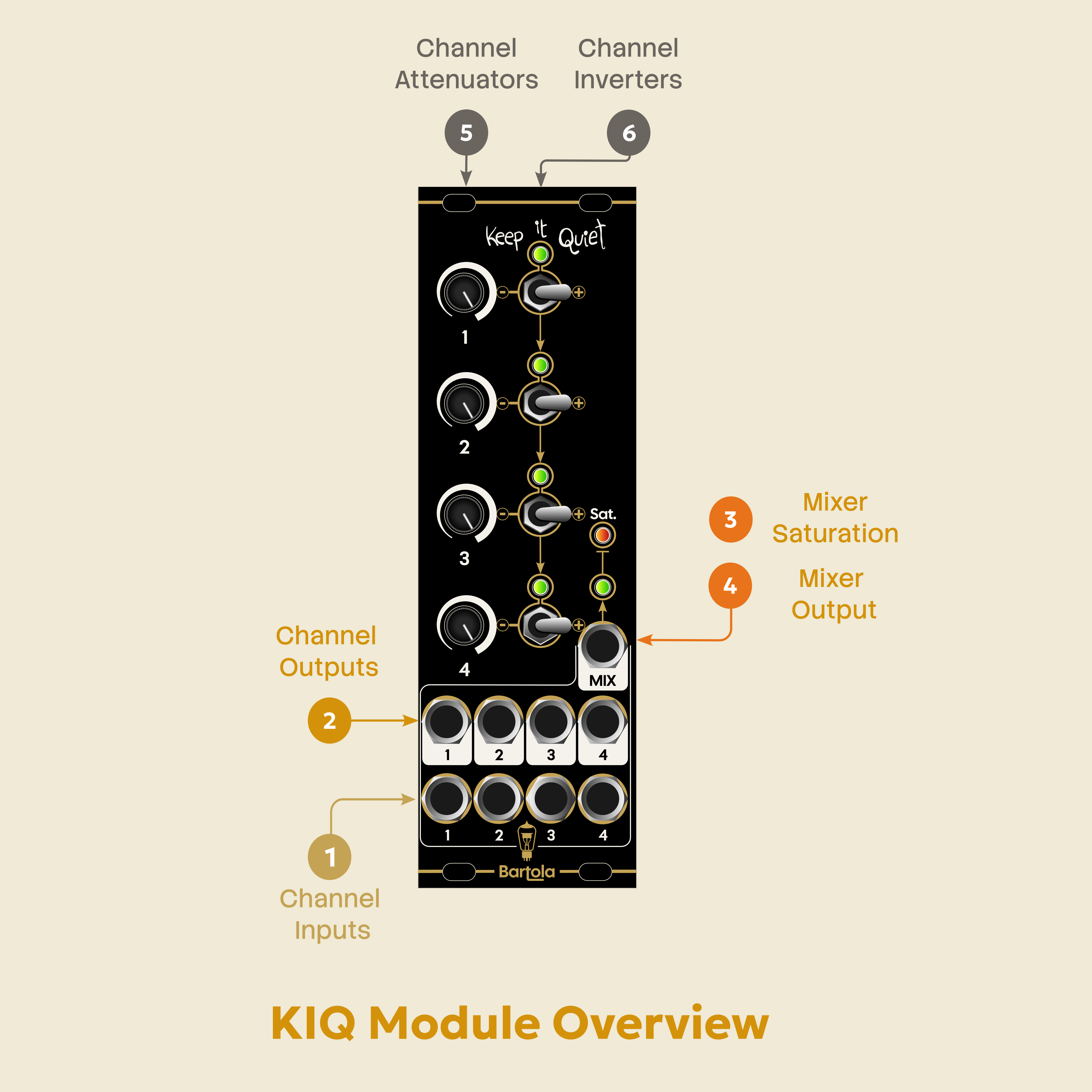
Channel Controls
A centre-zero pot found in a typical attenuverter gives you only half the travel for each polarity, halving your attenuation resolution; changing polarity means re-dialling your level. KIQ separates the two: a log-taper attenuator for precise, repeatable level setting and a dedicated switch to flip polarity instantly without touching the attenuation creating new performance posibilities.
Each of KIQ's four channels is a complete signal conditioner: an attenuator, a polarity inversion, and a live contribution to MIX, all in one block.
Attenuator — ⑤ : Log-taper pot, zero to unity gain. Log taper gives finer control at lower levels — exactly where KIQ lives. Full clockwise = unity.
Why log taper? Most attenuators use linear pots: equal voltage change per degree of rotation. That's fine for setting extremes, but most real-world use is small, repeated adjustments: nudging a filter, dialling in a hint of pitch modulation. A linear pot gives you the same coarse resolution there as it does at the extremes.
KIQ's log-taper pot allocates more of its rotation to that low-level range, so small movements produce small, predictable changes designed for musical adjustments, not mathematical ones.
Polarity switch — ⑥ (− / +): Flips the signal polarity. Left (−) inverts, right (+) passes through. Combined with the attenuator, each signal conditioner delivers any level from − unity to + unity.
Bipolar LED: Shows signal level and polarity at a glance:
- Green: positive CV or positive offset
- Yellow: negative CV or negative offset
- Both (flickering): bipolar signal: audio or bipolar LFO
The Cascade
Every channel always contributes to MIX — ④, patched or not. When a channel output — ② is left unpatched, it also normalises forward into the next channel, adding to that channel's output after its own attenuator and switch. Patching an output breaks only that forward normalisation: the signal goes to your patch destination, but the channel continues to feed MIX.
This means unpatched channels stack freely. Ch1's processed output adds directly into Ch2's output (after Ch2's own attenuator and switch), so both channels remain independently scaled.
Example: filter with offset + modulation:
- Ch1: no input → normalised to internal +5V → knob sets base cutoff offset
- Ch2: envelope or LFO → knob dials modulation depth, switch sets direction
- MIX → filter CV input
One module, one output: a static offset and a scaled modulation signal, each dialled in independently. No extra modules needed.
The same logic extends across all four channels: all channels contribute to MIX, and any unpatched channel also feeds forward into the next channel.
Note: to send one signal to multiple channels at different attenuation levels simultaneously, mult the signal or use stacked cables before patching into KIQ: each channel input is independent.
Offset Voltage
When nothing is plugged into a channel input — ①, it normalises internally to +5V. This is not shown on the front panel.
With the attenuator and polarity switch, any unpatched channel becomes a precision offset generator: - Switch right (+): 0V to +5V - Switch left (−): 0V to −5V
Use it to transpose a VCO, bias a VCA, set a filter cutoff, or inject a static offset into a CV sum without a separate offset module.
Mix Output and Saturation
All channels sum into MIX — ④ regardless of whether their individual outputs are patched. A soft-clip circuit keeps the output within Eurorack levels:
- MIX LED: bipolar LED. Green: positive sum, yellow: negative sum, both: bipolar or audio signal. Monitor overall mix polarity and level at a glance.
- Sat. LED — ③ (red) illuminates at 10Vpp: soft clipping begins. Use it as a mixing headroom guide.
- Hard clipping begins close to 11Vpp.
Some soft saturation is musical on audio. On CV, watch the Sat. LED and back off to stay clean.
Signal Flow
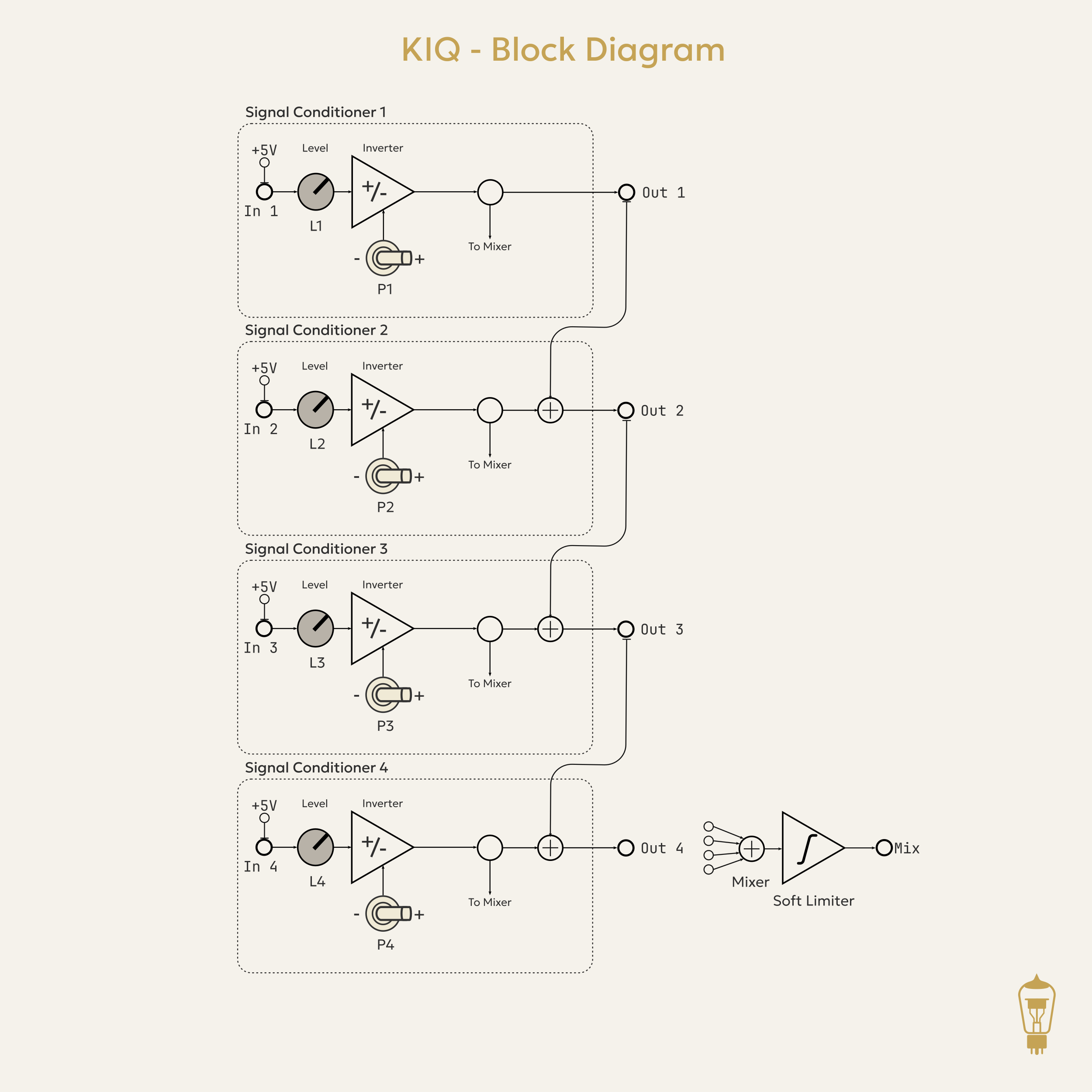
Each signal conditioner's output feeds forward into the next channel's summing junction when left unpatched, and taps off to the Mixer independently so MIX always receives each channel's own conditioned signal exactly once, whether or not that channel is also cascading into its neighbour. The Mixer's combined sum passes through the Soft Limiter before reaching MIX.
Use Cases
Dialling in modulation depth: The core use case. Patch an LFO, dial back the attenuator. Log taper gives fine control at subtle levels. Flip the switch to reverse modulation direction.
Offset + modulation in one output: Leave a channel unpatched to generate an offset, feed a modulation source into the next channel, take MIX to your destination. Base level and modulation depth independently controlled.
Signal inversion: Need an inverted envelope to close a VCA for side-chain compression or signal ducking? Switch to −, full clockwise.
Sub-mixing: Group channels 1–2 for one signal bus, 3–4 for another — take individual outputs. Or leave all four cascaded and use MIX as a master sum. Create your own stereo SEND effect mixers with a couple of KIQs!
Complex waveform generation: Feed different signal sources into all four channels, each scaled and inverted independently, and take MIX as the composite output.
Specifications
| ▣ Width | 8 HP |
| ⚡ Power | +12V @ 55 mA / −12V @ 55 mA (peak per rail) |
| ⊕ Protection | Reverse polarity · Keyed 10-pin IDC. Overvoltage on supply rails, inputs and outputs. |
| ↕ Depth | 32 mm (inc. power connector) |
| → Input impedance | 50 kΩ |
| ← Output impedance | 1 kΩ |
| THD | <0.01% @ 20kHz / 5Vrms |
Get in Touch
Questions or feedback: get in touch.